










































HPV Vaccination in Papua New Guinea to Prevent Cervical Cancer in Women: Gender, Sexual Morality, Outsiders and the De-feminization of the HPV Vaccine
Papua New Guinea Institute of Medical Research (Kelly-Hanku, Ase, Aeno, Fiya, Toliman, A.J. Vallely); UNSW Sydney (Kelly-Hanku, Newland, Aggleton, L.M. Vallely, Toliman, Kaldor, A.J. Vallely); Australian National University (Aggleton); University of Papua New Guinea (Mola)
"[P]articipants recommended...that any future vaccination programme be conducted openly and transparently, with attention being given to good face-to-face communication, and with the fears of local people being engaged with and treated with respect."
As vaccines are introduced into and scaled up in different cultural contexts, the meanings ascribed to them and the responses they incite are transformed through local engagement. Vaccination against the human papillomavirus (HPV) has not been without controversy, triggering debates about adolescent girls' sexuality and childhood immunisation more generally. This paper examines community discourses about the impending introduction of the HPV vaccine in women in Papua New Guinea (PNG), which has among the highest rates of cervical cancer and cervical-cancer-related deaths globally.
Early HPV vaccination campaigns in other contexts were aimed primarily at young girls and women and marketed as an anti-cervical-cancer vaccine, with the net effect that the vaccine came to be seen as "a girl's vaccine" and fed into what was later described as the "feminisation of HPV", thereby minimising the role it might play in the prevention of HPV-related conditions and cancers in men. Prior to the introduction of any new vaccine, let alone one so strongly "gendered", understanding community preparedness is thought to be critical.
The PNG study sites were Eastern Highlands (EHP), Western Highlands (WHP), and Milne Bay Provinces (MBP). Twenty-one gender-specific focus group discussions and 82 semi-structured interviews were conducted by a researcher of the same gender. The researchers sought to recruit participants of various ages, educational and marital statuses, including parents who, if a vaccine was currently available in the country, might face the option of vaccinating their children or not. In addition to young people who were slightly older than the age group that would be vaccinated, older people who could reflect on wider cultural norms and values about understandings of illness and of vaccine acceptability and opinion leaders in communities, such as cultural leaders, were recruited to the study.
Prior to the enquiry into HPV vaccine readiness, all participants were provided with up-to-date information on the vaccine, including the fact that it was a vaccine being considered by the government of PNG to be rolled out. Following this pre-prepared script, all participants were asked to discuss their thoughts and concerns about the introduction and the reasoning behind such beliefs.
Two primary themes emerged across the 3 provinces in terms of community discourses about the HPV vaccine and preparedness for its implementation:
- Protecting the body and vaccination acceptance: Study findings suggest overwhelming support by participants for the introduction of the HPV vaccine. In fact, it was seen as an important vaccine for both girls and boys. Five sub-themes emerged:
- Age of vaccination - Most participants spoke of 8 years being an appropriate age to start vaccinating against HPV. The explained this low age by pointing to perceptions of early sexual debut in Papua New Guinea, both through sexual relations that were consensual and those that were not.
- Cost of the vaccine - All participants believed the vaccine should be provided free of charge, or at least at minimal cost.
- Vaccination for both girls and boys - One of the health narratives that circulated concerned the importance and value of boys and men in keeping the women and girls of PNG healthy and HPV/cervical cancer free (though males are vulnerable to HPV-related cancers as well).
- Prioritisation of vaccination - Although a very high acceptability of vaccinating both girls and boys was evident, the relative importance of vaccinating girls and young women was positioned in terms of their biological and social responsibility as potential mothers and as those who are at risk of cervical cancer.
- Sex, safety, and promiscuity - Issues of sex and sexual freedom were raised. This was particularly related to the moralising of sex through the use of phrases in Tok Pisin that translate to "promiscuous" and "promiscuity". Although the overall consensus was that vaccination should be supported, participants stressed that care should be taken to ensure that the vaccine does not give license to those vaccinated to go out and have "a lot of sex".
- Discourses of apprehension: Especially in the rural study sites, participants expressed anxiety and apprehension about the purpose of the vaccine and the motives of "outsiders" in introducing it. Three sub-themes emerged:
- Stories, uncertain biomedical information, and side effects - In the absence of good-quality health information, and in a culture with strong oral traditions and low literacy rates, people frequently rely on stories to make decisions about health practices, including participating in childhood vaccination programmes. Benisha, an older woman living in a rural area in EHP, suggested that in order to reduce the effects of negative and moralising stories - in the form of gossip - circulating in the community, future HPV vaccination campaigns needed to be undertaken visibly and publicly.
- The perceived lowering of children's intelligence and deceit - Rosalita from EHP was concerned that vaccinations were given to children who are "not even sick". The health workers do this, she said, to "stop their knowledge" and prevent the children from developing intellectually. She said healthcare workers often "mislead" and "deceive" parents into vaccinating their children - "They are lying to us".
- Infertility - Some feared that the HPV could cause infertility, which is a serious health issue with socio-cultural ramifications in a country where reproduction and having children to continue the family line is important.
This study reveals that, though acceptance of the HPV vaccine for both girls and boys in PNG is high, central to success of introducing it will be engagement with and respect for local cultures and beliefs about health and illness. In particular, attention needs to be given to how "outsiders" are likely to be perceived by those that community vaccination programmes seek to reach. A first step would be to counter stories spreading misinformation and moralisation by providing accurate information about what it is that HPV vaccination seeks to achieve, as well to share the relevant and evidence-informed messages about the vaccine. "Community education has a key role to play in this respect, but it is important too to change the culture of vaccination programmes, too many of which have in the past adopted a top-down approach with information not being provided to participants in the mistaken belief that they cannot (or will not) understand."
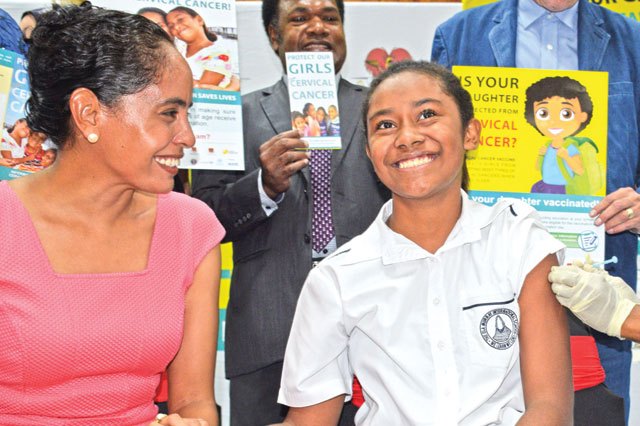
Papillomavirus Research, Volume 8, December 2019. https://doi.org/10.1016/j.pvr.2019.100171. Image credit: PNG Education News
- Log in to post comments