










































I Immunise: An Evaluation of a Values-Based Campaign to Change Attitudes and Beliefs
Immunisation Alliance of Western Australia, and Murdoch University
"Information, including the reporting and translation of scientific data, is important, but community-based interventions can employ mechanisms building upon social norming, values-framing and story-telling."
This paper presents the results of a study determining the efficacy of a values-based approach to changing vaccination attitudes. It reports an evaluation survey of the "I Immunise" communication campaign, conducted in Fremantle, Western Australia (WA), in 2014. Fremantle reports amongst the lowest vaccination coverage rates in Australia, with 85.6% of one- and five-year-olds fully immunised, and 86.6% of two-year olds.
As the researchers explain, when refusers cluster, local vaccination rates are lower than national averages, threatening herd immunity. This has inspired some to form action groups to promote vaccination at local, national, and international levels. In Australia, examples include the Stop the Australian (Anti)Vaccination Network Facebook group and Northern Rivers Vaccination Supporters. The latter model of vaccine intervention uses a model deriving from communities utilising local advocates, who share messages through stories. "This relationship between information, values, identity, lifestyle and story-telling can be conceptualised as a social-identity theory based approach to (lasting) attitudinal change, advanced as best practice by leading policy researchers....Such an approach takes seriously the social relationships between humans, the ways in which identities are formed within and through these relationships, and the construction of social norms that encourage us to act in ways that affirm them."
Along these lines, the Immunisation Alliance of WA, a not-for-profit pro-vaccination advocacy organisation, launched "I Immunise", which explicitly engaged with values and identity through a campaign formulated by locals in a community known for its alternative lifestyles. "The campaign designer's experiences within the Fremantle alternative community via home-birthing, breastfeeding, baby-wearing and cloth-nappying forums, indicated that vax-hesitant views were hegemonic in these settings." The "I Immunise" campaign "used community advocates and explicitly appealed to (because it derived from) local values around social justice, parenting and alternative lifestyles."
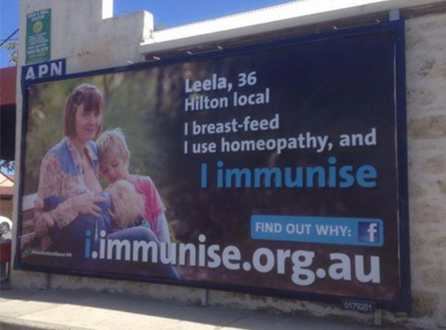
Specifically, the campaign "featured six Fremantle residents who identified as living an alternative lifestyle. Campaign development involved collaborating with each spokesperson to develop a 300-word testimonial outlining why vaccination was part of his or her alternative lifestyle. These testimonials featured on a website along with professional photographs of the spokespeople in iconic Fremantle locations. Each spokesperson's testimonial was distilled into a poster, listing first name, age, number of children and two core lifestyle attributes, followed with the words, 'I Immunise.' Lifestyle attributes included home-birthing, breastfeeding, baby-wearing and eating wholefoods. One mother breastfed in her photograph; a father wore his baby son in a wrap made by his artisan wife." Two of these posters became billboards, erected for a month; others became large signs displayed on public buildings; four featured as weekly advertisements in an independent newspaper; and each became a meme on the I Immunise Facebook page. The series of six posters was distributed to doctors' offices, child health clinics, maternity services, childcare centres, playgroups, and private businesses in Fremantle. The campaign attracted local state and national media attention, particularly after the billboards were vandalised by supporters of the Australian Vaccination Skeptics Network.
Audiences for "I Immunise" included "in the closet" and "out and proud" vaccinators. The latter featured in the campaign, whereas the former were its second audience. "Given the hegemony of vax-hesitant views in the alternative community, we expected many parents who fully vaccinated kept this quiet to avoid conflict with peers. By encouraging these individuals to move out of the closet and claim legitimacy as 'alternative' parents, the campaign sought to alter community discourse..."
The campaign was evaluated by collecting qualitative and quantitative data via an online survey of 304 respondents. Just over half of the participants reported they had either refused, doubted, or worried about vaccinations for their children (56.5%). There were significantly more vaccine-hesitant participants in the alternative lifestyle group (72.0%) than in the non-alternative-lifestyle group (56.5%). For the alternative lifestyle group, the most visible elements were the campaign website (36.6%), the billboards (24.7%), and stories in the local paper (20.4%). For the non-alternative lifestylers, the most visible element was the campaign website (over 41%), with all other elements (except a stall at a local farmers' market) being seen by a similar number of respondents.
There were 180 (59.2%) respondents indicating a positive impact of the campaign (either feeling or thoughts), 51 (16.8%) indicating a negative impact (either feelings or thoughts), and 73 (24.0%) indicating no impact on feelings or thoughts. There was no significant difference between the alternative lifestyle respondents' positive, negative, or nil impact and non-alternative lifestylers' positive, negative, or nil impact. Of the 67 alternative lifestyle participants indicating an impact from the campaign, 48 or 71.6% of them reported a positive impact. They reported that they would take actions such as getting their own vaccinations updated, sharing the campaign on their Facebook "even though I knew some of my friends would strongly disagree", or keeping their children away from those who were not immunised. Of the 156 non-alternative lifestylers, 125 or 80.1% reported a positive impact.
Analysing just those respondents who reported any impact from the campaign, significant differences were found between hesitant and non-hesitant, indicating that negative thoughts and feelings were more likely to be generated by this campaign for vaccine-hesitant participants. Put another way, the cohort who had refused a vaccine showed a high level of negative responses to the campaign (69.2% compared to 2.1% for those who had never refused a vaccine), suggesting that the campaign was tapping into vaccine refusers rather than vaccine-hesitant individuals.
Respondents who reported feeling and thinking more negatively about immunisation after seeing the campaign gave a range of reasons. "Some rejected the perceived propaganda and emphasised the importance of their right to choose. Others emphasised their distrust with the information's source and its links to government and pharma. There were also complaints that the material was one-sided and that it stereotyped people based on lifestyle and vaccine decisions....[M]ore research is required into how these attitudes develop and how communities, governments and health professionals can effectively challenge them."
That said, in light of the fact that the key effect of the campaign this research sought to measure was whether it had made alternative lifestyle parents think and feel more positively about vaccination, the researchers note that the campaign had an overall positive effect for at least 77%: 71% of the alternative lifestyle group and 80.1% of the non-alternative lifestylers.
Future research directions, in addition to that suggested above, include looking into the emphasis on social responsibility articulated in some of the testimonials of the "out and proud" vaccinators. Since studies have demonstrated that parents make vaccination decisions primarily about their own children rather than the benefit to others, the researchers suggest further investigation into "how, and whether, social responsibility can be enhanced through pro-social norms within specific communities, and whether campaigns such as 'I Immunise' could be transferable to other similar communities."
Along those lines, the researchers surmise that the findings are potentially applicable to other similar communities. They write, "There are isolated 'Fremantle-type' individuals throughout broader populations, connected by online and social media, and there are other communities with apparent similarities to Fremantle in terms of lifestyle and values...While similarities between national and international 'hesitant communities' need to be mapped and cross-national virtual 'hesitant communities' also require investigation, we hope our strategy and limited findings will help researchers in those settings develop and test new ideas. However, all campaigns should be conceived, developed, tested and executed by committed members of local communities, to fit the authenticity needs of their audiences."
Vaccine, Volume 33, Issue 46, Pages 6235-6240.
- Log in to post comments