










































Networks for Change and Well-Being: Girl-Led 'from the Ground up' Policy Making to Address Sexual Violence in Canada and South Africa
Led by the University of KwaZulu-Natal and McGill University, with funding from the International Development Research Centre (IDRC) and the Social Sciences and Humanities Research Council of Canada (SSHRC), this 6-year research project was launched in January 2013 to provide evidence that will hopefully help transform the policy and programme landscape for girls' safety and security in South Africa and Canada. In various locations across both countries, the research is examining how youth-led media influences community practitioners and policymakers, thereby aiming to shift the boundaries of knowledge production and inform policy change. The project focus is on learning from the contexts in which communities of girls and young women are subject to exceptionally high rates of sexual violence. In the Canadian context, this refers to self-identified young Indigenous girls/women, including First Nations, Métis, and Inuit, status or non-status, beneficiary or non-beneficiary, and includes Indigenous girls and young women who identify as trans, two-spirit, or gender non-conforming. In the South African context, the project is working with girls and young women of a range of sexualities who belong to two of the official government designated groups, black and coloured (mixed race), and who live in rural areas.
The project team is investigating how knowledge about sexual assault is co-created by girls and young women in different settings, with a particular focus on innovative approaches to sharing information. The project's methodology draws on approaches to learning such as digital storytelling, participatory video, cellphilms (films made with cell phones), drawing and mapping, community radio, and social media. It also builds on youth-led media making, community-based research, participatory action research, research as a form of intervention, and research as a way to generate social change. The partnership project is organised into six working groups:
- Digital/participatory interventions
- Girls as knowledge producers and mobilisers
- Engaging policymakers
- Communication for social action
- Land and place
- Ethical practice
Specific activities carried out by these groups include:
- Conducting research into the role girls can play to inform the study and eradication of sexual violence;
- Analysing the impact of participatory policymaking;
- Advancing understanding of how digital and social media tools can be used in participatory research;
- Developing new communication approaches to prevent and address sexual violence;
- Training and supporting girl-focused solutions;
- Engaging policymakers in girl-led dialogues;
- Creating a transnational platform for raising awareness and advocacy;
- Supporting masters, doctoral, and postdoctoral students from the two countries; and
- Organising training institutes for graduate students in participatory policymaking and digital and social media.
To look at one event in more detail, the International Participatory Visual Methodologies (PVM) Summer Institute was hosted at McGill University and featured a one-day "Speaking Back" workshop, attended by 30 PhD students and researchers from Sweden, South Africa, and other parts of Canada, followed by participation for all attendees in the International Visual Sociology Association Conference (June 19-22, 2017). The preconference event explored the theme of "Speaking Back" through two participatory visual methods using the prompt "Feeling Safe and Feeling Unsafe". The first approach was photovoice, which involved participants creating poster narratives, reflecting on the process, and sharing their reflections with the group. The second visual method was cellphilm production, which considered how to "Speak Back" to their photo voice pieces. This exercise produced a series of five 60-second cellphilms, which were then screened to the entire group and followed by a reflection and question period.
Additional events associated with the PVM Institute included the launch of the inaugural issue of the policy brief Using Everyday Media Making Tools to Address Gender-Based Violence: Participatory Visual Methodologies and Community-Based Technologies. There were also numerous talks and presentations by partners associated with the Networks for Change partnership, such as Mi'kmaq scholar Mallery Denny, who discussed her use of participatory methods to work with youth in her community of Eskasoni. Artist in Residence Maria Ezcurra exhibited and discussed her work Altar for the Dead, which honours murdered and missing Indigenous women and girls in Canada.
To cite an example of youth activism in relation to community and policy engagement, on August 9, 2017 in Khethani, Winterton, South Africa, the project held a Networks for Change march led by girls and young women to raise awareness about sexual violence. Held as part of Women's Day events, the march featured groups such as the Leaders for Young Women's Success (L4YWS) and the Social Ills Fighters. The latter performed a song about violence against girls and women during the community dialogue following the march.
The Networks for Change and Well-Being website includes information about each of the project field sites in South Africa and Canada, the working groups that underpin the project, and a gallery exhibiting images from the project. Other resources relating to sexual violence and girlhood are also available, such as websites, toolkits, and resources for indigenous methodologies. Periodic newsletters provide updates on the project.
For example, as part of one of the field site's projects, Girls Against Sexual Violence and Abuse (GASVA) undertook efforts to tackle sexual and gender-based violence (SGBV) on the Durban University of Technology (DUT) campus. Drama, demonstrations, posters, and creative artwork were used to educate, raise awareness, and spark dialogue about SGBV in and around campus. One media project involved the development of a video featuring two members of GASVA and two members of Amajita, a young men's group that started as an offshoot of GASVA to support non-violence and complement GASVA's activities. The video addressed clothing and the ways in which women's clothing is used as a justification for sexual harassment and rape.
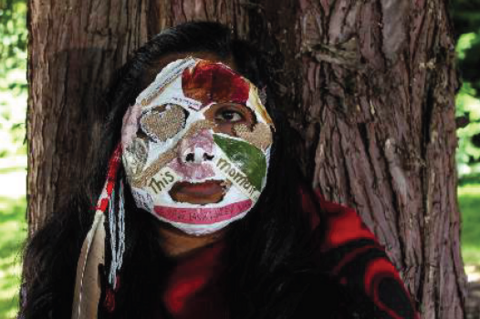
The image at the beginning of the summary is from Sisters Rising, which is being carried out at a field site in Indigenous territories in British Columbia in western Canada. Working with the research team and knowledge holders such as elders, Sisters Rising participants - girls and young women aged 13-26 who self-identify as Indigenous (Aboriginal, First Nations, Métis, mixed, Inuit, on- and off-reserve) - have been using applied, land-based, hands-on research methods to explore topics such as dignity, safety, sexualised and gender violence, land-based well-being, and Indigenous resurgence. The focus has been on using land-based materials such as rocks, wood, wool, and hide as a form of relational and political storytelling that connects bodied experiences with all relations. Some of the activities included mask workshops and a spoken word video.
Sexual Violence, Adolescence
The University of KwaZulu-Natal (South Africa) and McGill University (Canada) are leading this international and interdisciplinary partnership. The project brings universities, government agencies, and community-based organisations together. The International Partnerships for Sustainable Societies programme is funding the project. The South African team is largely supported by the International Development Research Centre (IDRC). The Social Sciences and Humanities Research Council of Canada (SSHRC) is providing support to the Canadian team.
Networks for Change and Well-Being, Issue 5, September 2017, sent via email from Liane Cerminara to The Communication Initiative on November 8 2017; IDRC website and Networks for Change and Well-Being website - both accessed on November 13 2017; and email from Liane Cerminara to The Communication Initiative on December 13 2017. Image caption/credit: Mask by Shantelle Moreno, Sisters Rising mask-making workshop with Shíshálh artist Margaret Briere. Photo: Nicole Land
- Log in to post comments